One decision layer for every material movement, robotic or human, reconciled against the system of record in real time.
Key Takeaways
- Ati Robotics built Ati Flow to close the gap between ERP, MES and WMS, the space on the shop floor where material in motion has no system of record and today relies on people to track it by hand.
- Ati Flow treats robots, third party equipment and human driven forklifts as the same kind of executor, routing every movement with deterministic, auditable logic rather than a model's guess.
- A validated execution flow, generate the intent, validate it, scan the material, dispatch and confirm, cut rework at a global automotive deployment by ensuring only the requested material moves, in the requested quantity, once.
A factory runs on several systems, not one. ERP knows what was released. MES knows what a machine worked on. WMS knows what is in stores. Each is authoritative for its slice and blind to the rest, and none owns the space between them.
That space is run by people. A supervisor walks the floor to see what is actually moving. A planner calls stores to ask if material is really there. Once a month, production stops so someone can count. The human is the integration layer.
The problem is not too little automation. It is that nothing coordinates what already exists. This post is about the layer that does: the Orchestrate stage from Where We Stand on AI, in production form.
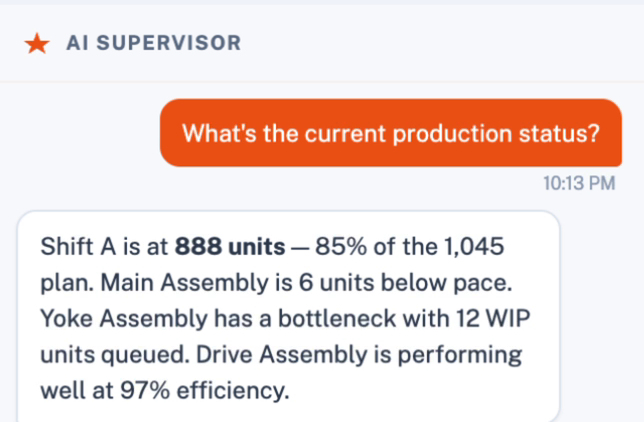
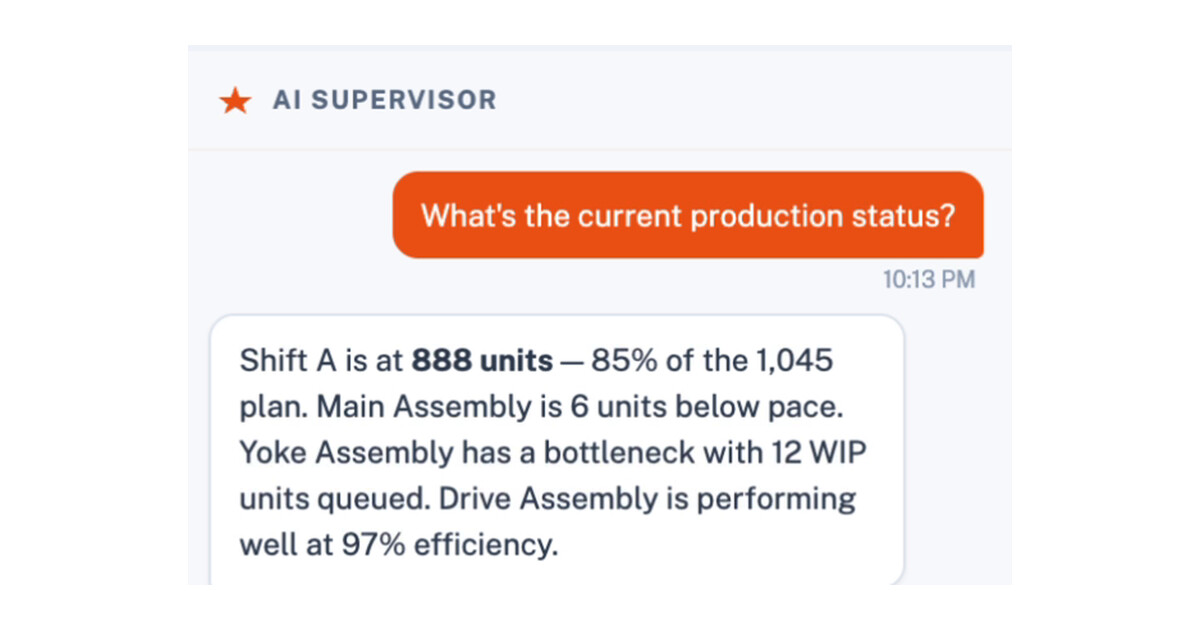
A shift supervisor types: what is the current production status? The reply: "Shift A is at 888 units, 85% of the 1,045 plan. Main Assembly is 6 units below pace. Yoke Assembly has a bottleneck with 12 WIP units queued. Drive Assembly is performing well at 97% efficiency."
Nobody compiled that answer. Every number in it traces to a tracked material movement on a live production line, and we sell the layer that produces it alongside the robots, not inside them.
The blind spot
The gap between the systems has a name. Once material leaves stores, ERP loses visibility; until it reaches a machine, MES has nothing to say. Work-in-progress is a defined inventory category with no system of record behind it.
The consequences are questions plant managers ask every day and cannot answer. I released 110 parts for this batch: can I release 105 for the next, or did rejects eat the margin? I released material an hour ago: why is the line not running? Usually the material is sitting in a QC staging queue that the planned flow does not even model; line starvation with inventory available is the standard failure, not the exotic one. Inventory audits still require stopping production (one to two days of output lost per month) because reconciliation is a physical count instead of a running total. And no screen in the plant shows all material flow in one place.
The factory's biggest data gap is not on the machines. It is on the floor between them.
The layer
Ati Flow sits in that gap. It joins four things that already exist: the ERP's record of what material there is, the MES's record of what the machines did, live tracking of every asset that moves (robots, manual forklifts, tagged trolleys, pallets through barcode and RFID gates, Ati Eye cameras at pick and drop points), and the orchestration logic that decides what moves next. Its responsibilities are material tracking in real time, WIP visibility across stations, movement orchestration, and exception handling for shortages, mismatches and delays. Routing is deterministic and auditable: FIFO, aging and priority rules, not a model guessing.
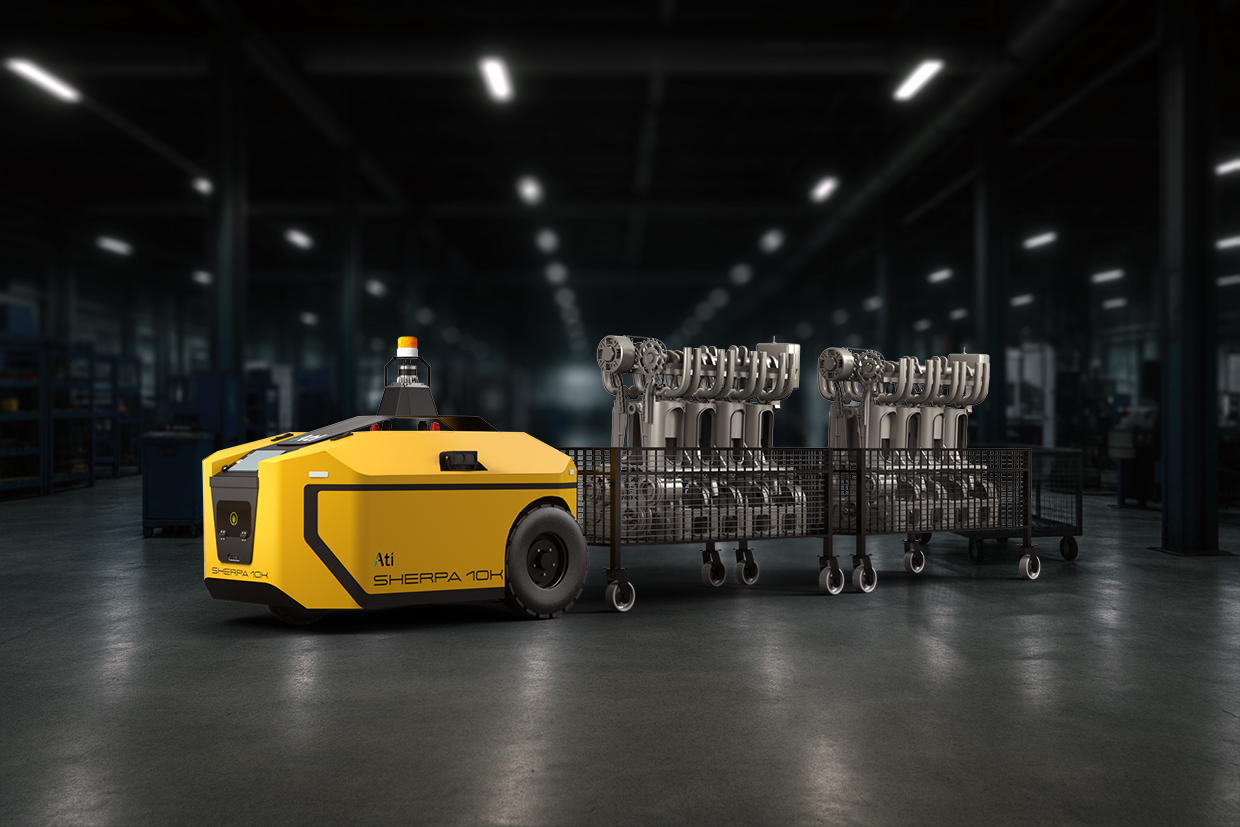
Two boundaries define it. Flow is not a fleet manager grown large: it coordinates our robots, third-party robots and human-driven forklifts under the same decision layer, treating each as one executor among several. A movement assigned to a forklift driver and one assigned to a Sherpa are the same object in the system, tracked to the same standard. And Flow is not analytics on top of a SCADA feed: dashboards report; this layer decides, dispatches and confirms.
Validated execution
The step that separates orchestration from automation is validation. In one deployment for a global automotive manufacturer, the shop floor was already highly automated and the ERP drove production intent, and rework still came from wrong material onboarded, incorrect quantities, and duplicate or failed task orders. Triggering a robot is easy. Trusting the trigger is the work.
The execution flow that replaced it: orchestration generates a movement intent; the fleet layer validates the request and accepts or rejects it; materials are scanned and checked against the request before dispatch; task orders are consolidated per vehicle; and the loop closes on delivery confirmation. Rework dropped because only requested material moves, in requested quantities, once. The line we use internally for the outcome is the accurate one: material flow became trustworthy, not just automated.
Throughput and efficiency
The robots sell throughput. This layer sells efficiency, and the two are priced and measured separately.
In production today, material deliveries run accurately: right SKU, right station, on takt. At a large electronics manufacturer with high-mix lines, line-starvation losses fell by more than 20% once queues became FIFO- and aging-aware; the stoppages had never been about missing inventory, only invisible inventory. WIP variance at reconciled sites is down from 4% to 2%, and the monthly audit stoppage is gone: reconciliation is continuous, so there is no count to stop for. On the line behind the chat exchange above, utilization reads 84.9%, live, with an hour-over-hour delta.
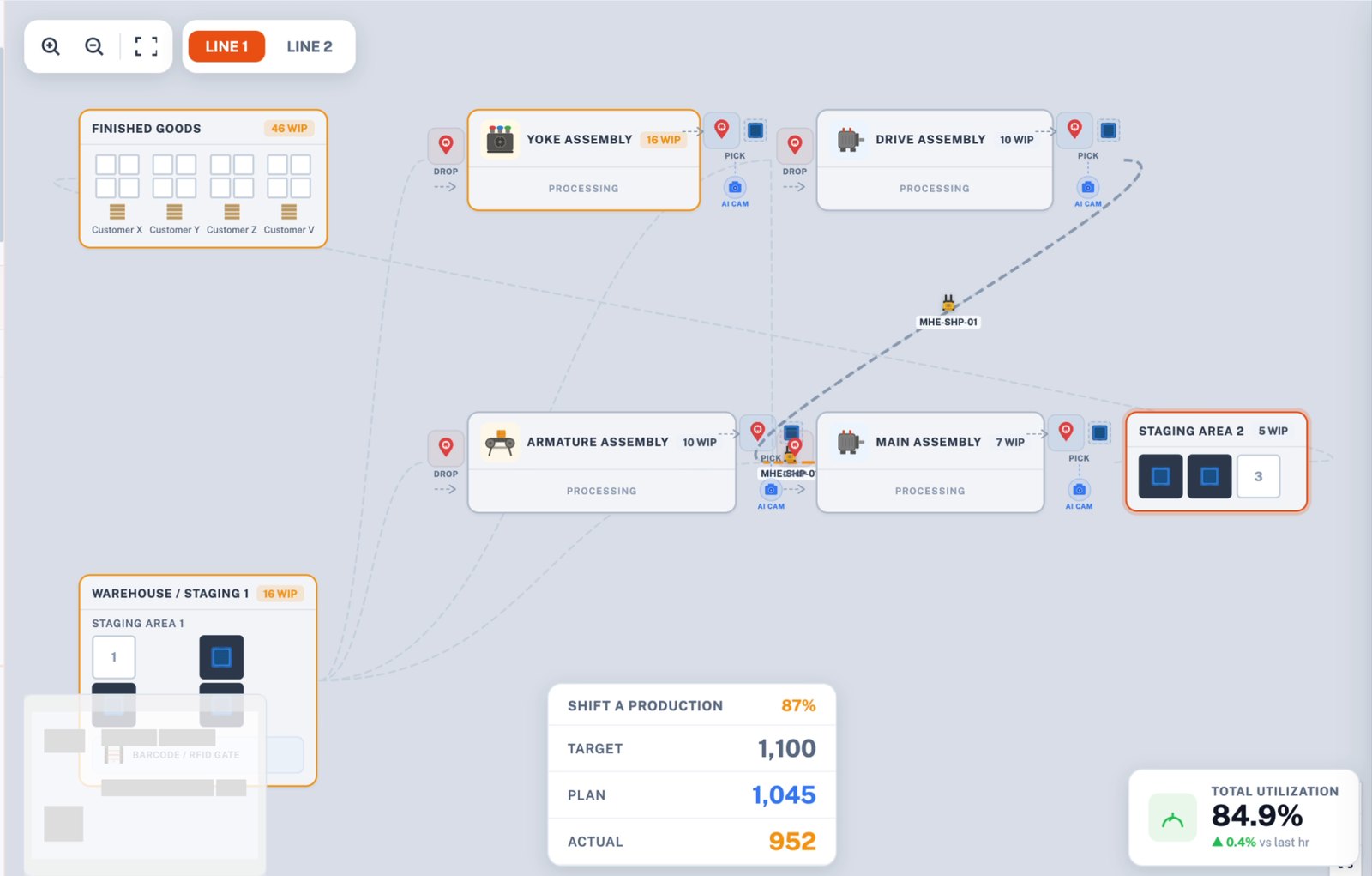
Efficiency has a second buyer, and it is not operations. Because every movement is attributable (what moved, when, by which vehicle or driver, against which order), the same record that feeds the supervisor's chat answers a finance team's variance analysis per SKU, with delta and current location. The audit trail is not a feature added for compliance. It is the same data the orchestrator runs on, read backwards.
Where the language model sits
Ati Supervisor is the interface to all of this: production status, bottlenecks, work orders at risk of delay, WIP aging reports, in plain language. It is worth being precise about what it is. The language model reads the reconciled material record and writes answers. It does not dispatch a robot, release material, or touch the execution layer. The rule is the same one the diagnostic agent in Robots That Recover Themselves lives under: the thing that reasons has no hands. Deterministic logic decides and acts; the model explains.
This is the factory brain from Where We Stand on AI in production form: Robots That Recover Themselves was its robot-side counterpart. Both learn on outcomes the fleet can verify; neither sits in the safety loop.
Status
Flow runs in production at automotive, electronics and tire plants, orchestrating mixed fleets of our robots, third-party equipment and human-driven vehicles against SAP, MES and WMS records. The claims above are from those deployments.
The factory in this post is agentic in a narrow, checkable sense: intents are generated, validated, executed and confirmed by software, exceptions become workflows rather than alarms, and a supervisor can interrogate the whole thing in plain language. Nothing in it requires believing a slogan. It requires a system of record for the one thing factories never had one for: material in motion.
Next: Wheels to Humanoids: what carries over from the fleet when the form factor changes.