Ati Robotics runs on narrow AI approaches. We do not run an end-to-end neural net today. That is a deliberate design choice, and this series explains why we made it.
Key Takeaways
- Ati Robotics does not run an end-to-end neural net driving the robot today. That is a deliberate design choice, not a gap we are working to close.
- End-to-end foundation models are a useful research result in our own trials, but not yet a shippable product when a stopped robot stops the line.
- AI shows up differently at each stage of a robot's life: design iteration in Research, site-specific perception models at Deploy, a live-access support agent in Operate, and fleet-wide coordination in Orchestrate.
- Safety belongs to neither the factory brain nor the robot brain. A certified, deterministic layer carries the safety case outside both learned systems, by design.
- The durable advantage is not the model. It is post-training on outcomes only a fleet can generate.
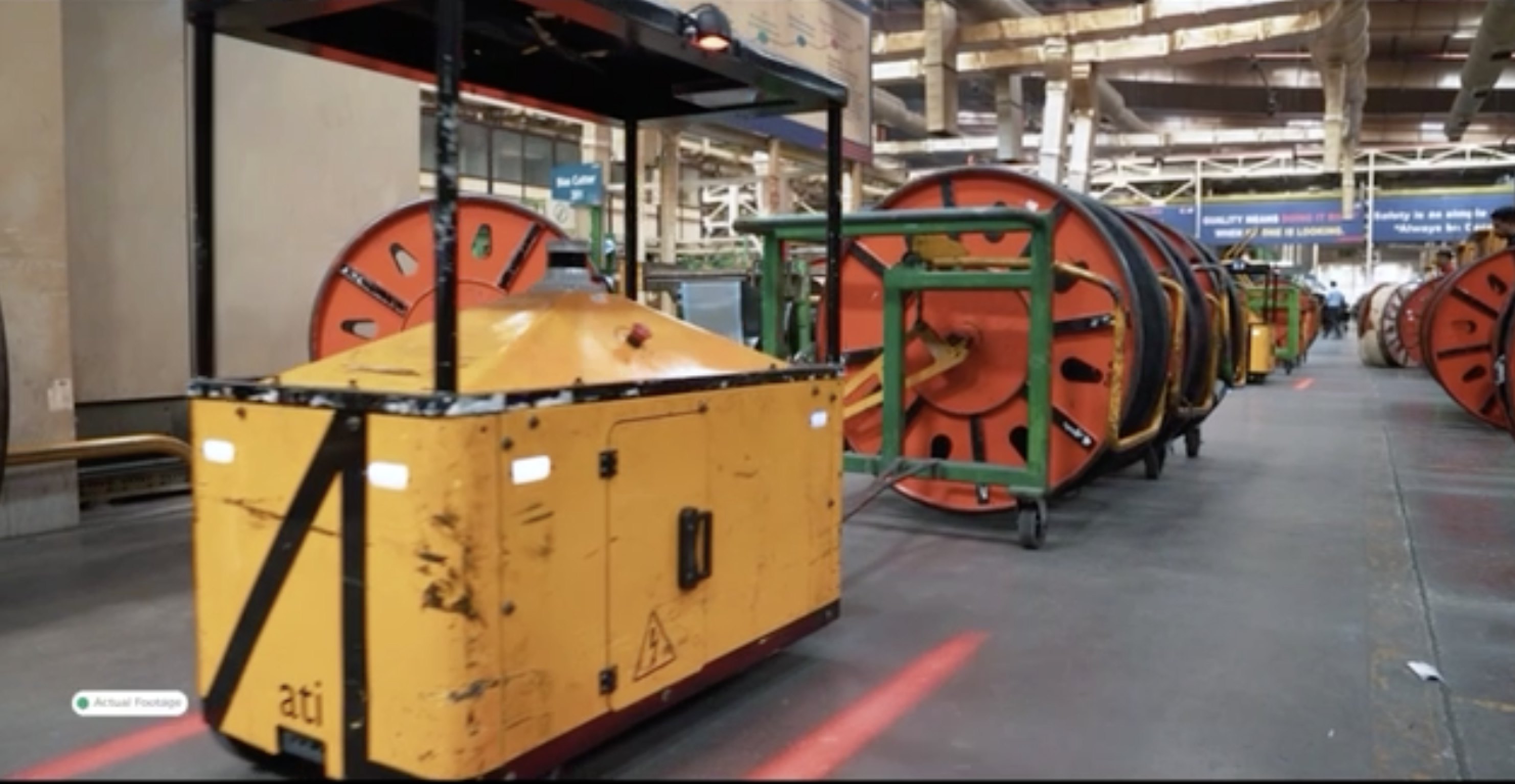 Figure: An Ati tug towing a train of cable reels down a live aisle at a customer factory.
Why we are writing this now. AI is changing conventional software work, and good engineers are moving toward physical problems. Most of them arrive with the same question: how much of the AI-in-robotics story is real? This series is our answer, based on a fleet running over a million missions a year across factories in India, North America and Southeast Asia. We call the approach Physical AI, and this is the engineering behind it.
What Exists Today
Vision-language-action models have moved to the center of robotics research in the last three years. The reported numbers are strong: on the standard simulation benchmarks, success rates routinely exceed 95% in controlled settings. The benchmarks are also saturated, and many leading researchers now see the remaining open problem as zero-shot performance in unstructured real environments. Here only a few closed frontier models are competitive.1
That said, production adds constraints these benchmarks do not measure. Field robots carry an onboard GPU sized for the control loop, not a data-center card. Robots run three shifts; some customers stop operations two or three days a year. Aisles are shared with people. If the robot stops, the line stops. Our own trials with end-to-end foundation models currently succeed roughly 75-80% of the time. That is a useful research result, but not a shippable product.
The question is where AI holds up under these constraints. We organize the answer around four stages of a robot's lifecycle.
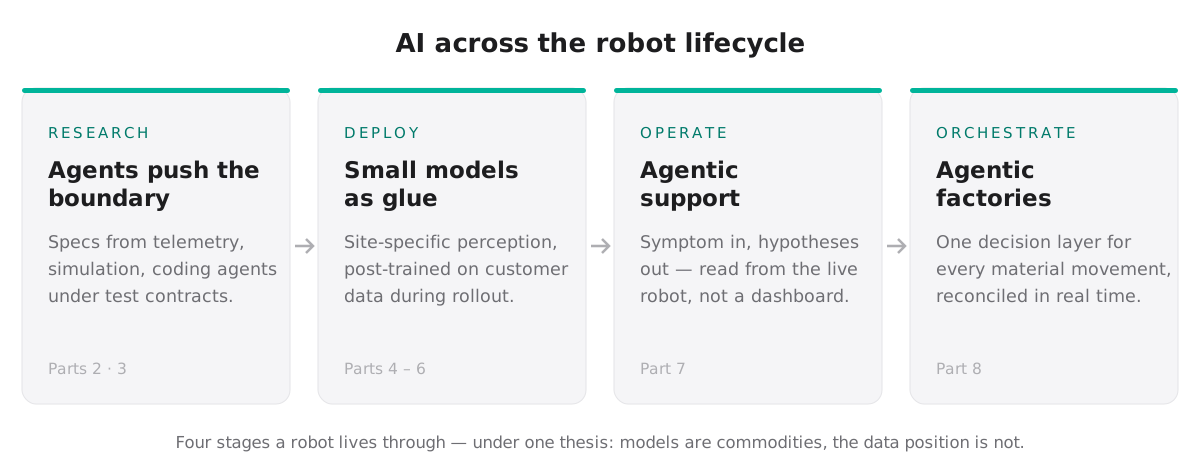 Figure: Research, Deploy, Operate, Orchestrate: what AI does at each stage.
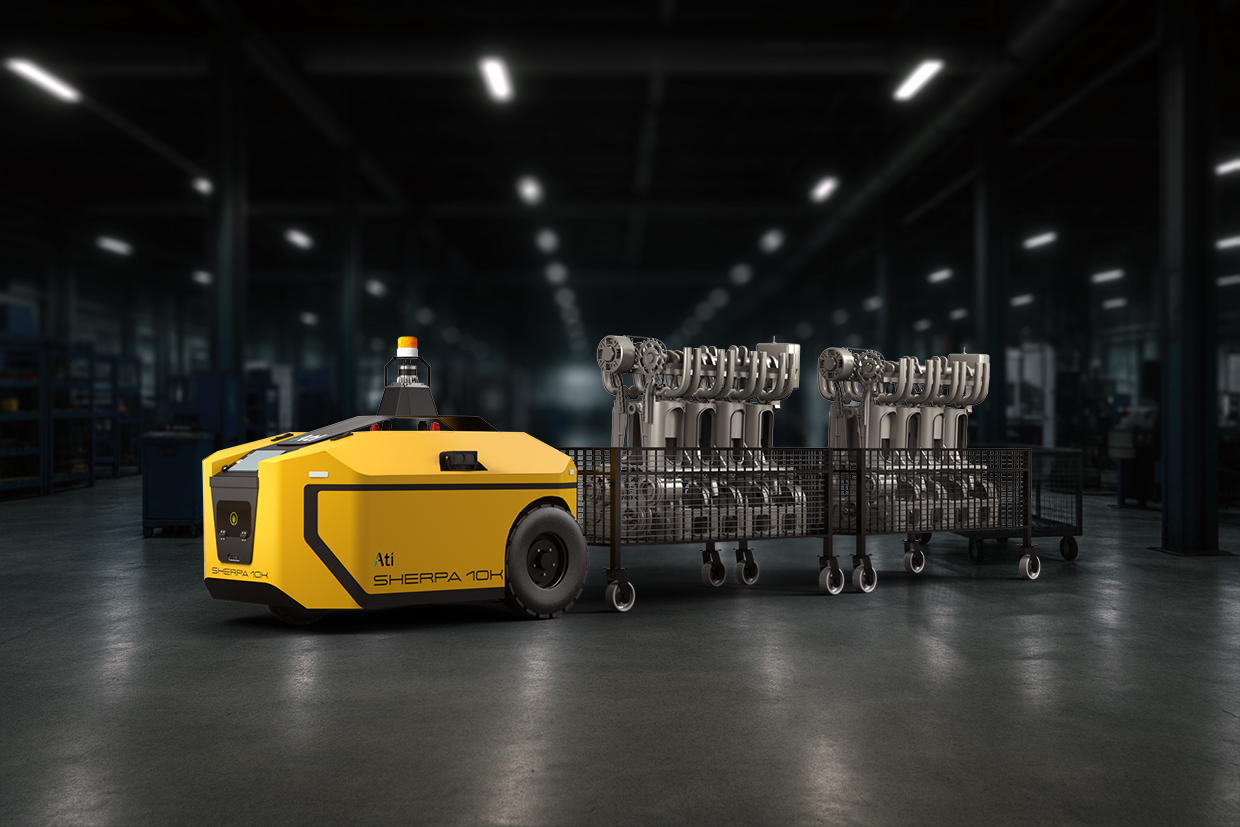
Research. AI agents run much of our design iteration: specs written against fleet telemetry, simulation, implementation handed to coding agents constrained by auto-generated test contracts. One customer asked that our Sherpa 10K make a compact U-turn at the dead end of a gangway. It went from a one-line brief to a production motion primitive in a week. Separately, we sponsor research on foundation-model navigation from a single RGB camera and are testing it on hardware. Parts 2 and 3 cover both, failures included.
Deploy. Site-specific perception problems get site-specific models: wet surfaces on outdoor routes, very small obstacles in live aisles, black cables on dark floors, right-of-way with other vendors' robots. Each is a small model post-trained on that customer's data during rollout. This works because we own the perception stack end to end; there is nothing to license and no vendor in the loop. Part 4 covers this in detail.
Operate. Support runs through an agent with live access to the machine. An engineer types a symptom; the agent searches our accumulated knowledge (code, docs, runbooks, solved tickets), forms hypotheses, and queries the robot directly through an MCP server that runs on every vehicle. Escalation to a human arrives with evidence attached. Part 7 covers this in detail.
Orchestrate. Above the fleet sits Ati Flow, a decision layer coordinating AMRs (ours and third-party), human-driven forklifts, tagged legacy assets, and the systems of record (SAP, MES, WMS). Every material movement, robotic or human, is reconciled against the digital record in real time. Part 8 covers this in detail.
Underneath all four stages sits one thesis:
Models are commodities. The data position is not. Every robot-hour produces verifiable outcomes: hitch engagement, on-takt delivery, approach smoothness. Each one is a training signal ready for reinforcement learning.
The durable advantage is post-training on outcomes only a fleet can generate.
Ati Architecture
Our AI stack is split across two places.
The factory brain handles orchestration: anticipatory planning, disruption recovery, predictive maintenance, root-cause analysis. It learns from verifiable rewards: on-takt delivery, throughput, recovery time.
The robot brain is a software supervisor on each vehicle. It restarts crashed processes, selects reduced-capability modes when hardware degrades, and escalates with evidence. It learns physical execution: hitching force, pickup accuracy, navigation smoothness.
Safety belongs to neither. The emergency stop, protective fields and speed limits near people are classical, certified and deterministic, and remain so. A neural network cannot be certified under the functional-safety standards that govern industrial mobile robots (ISO 3691-4); a small deterministic monitor with bounded execution time can. Learned layers provide capability. The classical layer carries the safety case. Part 10 treats this in full.
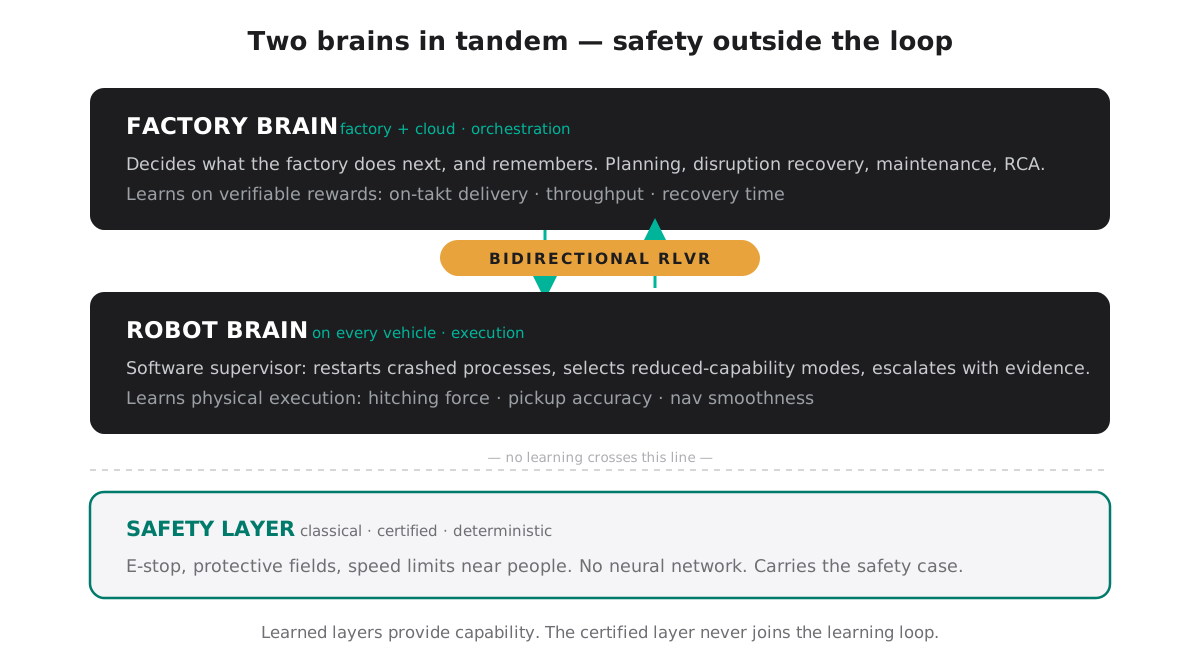 Figure: Factory brain and robot brain in a learning loop; the certified safety layer sits outside it.
Takeaway
The rest of the series works through these ideas. Research bets that paid off and one that has not yet; the small models we ship and the committee that finds a lost robot; two problems where we chose math over learning, and what that choice cost and bought. We would rather publish the failure rates than the demo reel.
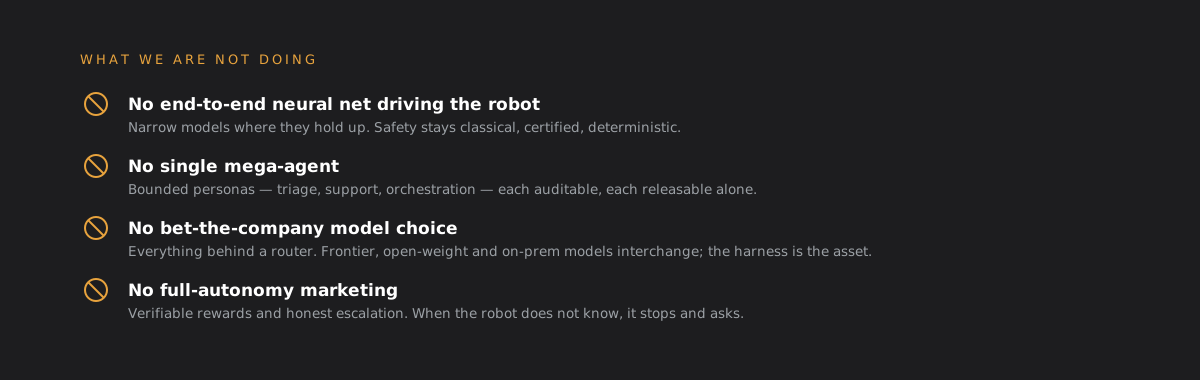 Figure: Four refusals: no end-to-end neural net driving the robot, no mega-agent, no bet-the-company model choice, no full-autonomy marketing.
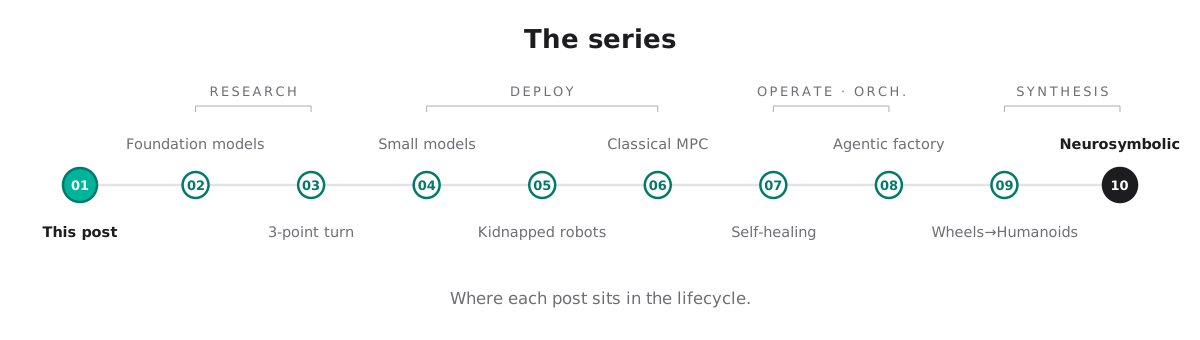 Figure: Series map: ten parts across the four lifecycle stages.
What This Means on Your Floor
Key Takeaway
The robots moving material in your plant do not depend on a single model that may or may not generalize to your aisles. They run small, purpose-trained models fitted to your site during rollout, sit under a certified classical safety layer, and get better with every mission the fleet completes. The AI is real, it is specific, and it is already in production.
1. The reading of the field in this paragraph follows Moritz Reuss, "State of Vision-Language-Action (VLA) Research at ICLR 2026", a survey of the VLA papers submitted to ICLR 2026, which finds the standard simulation suites effectively solved and identifies zero-shot, open-world behavior as the open problem, with only a few closed frontier models competitive there. ↩
Next: The Promise of Foundational Models. An ICRA 2026 navigation model, deployed on hardware within weeks of publication, and what its failure modes taught us.