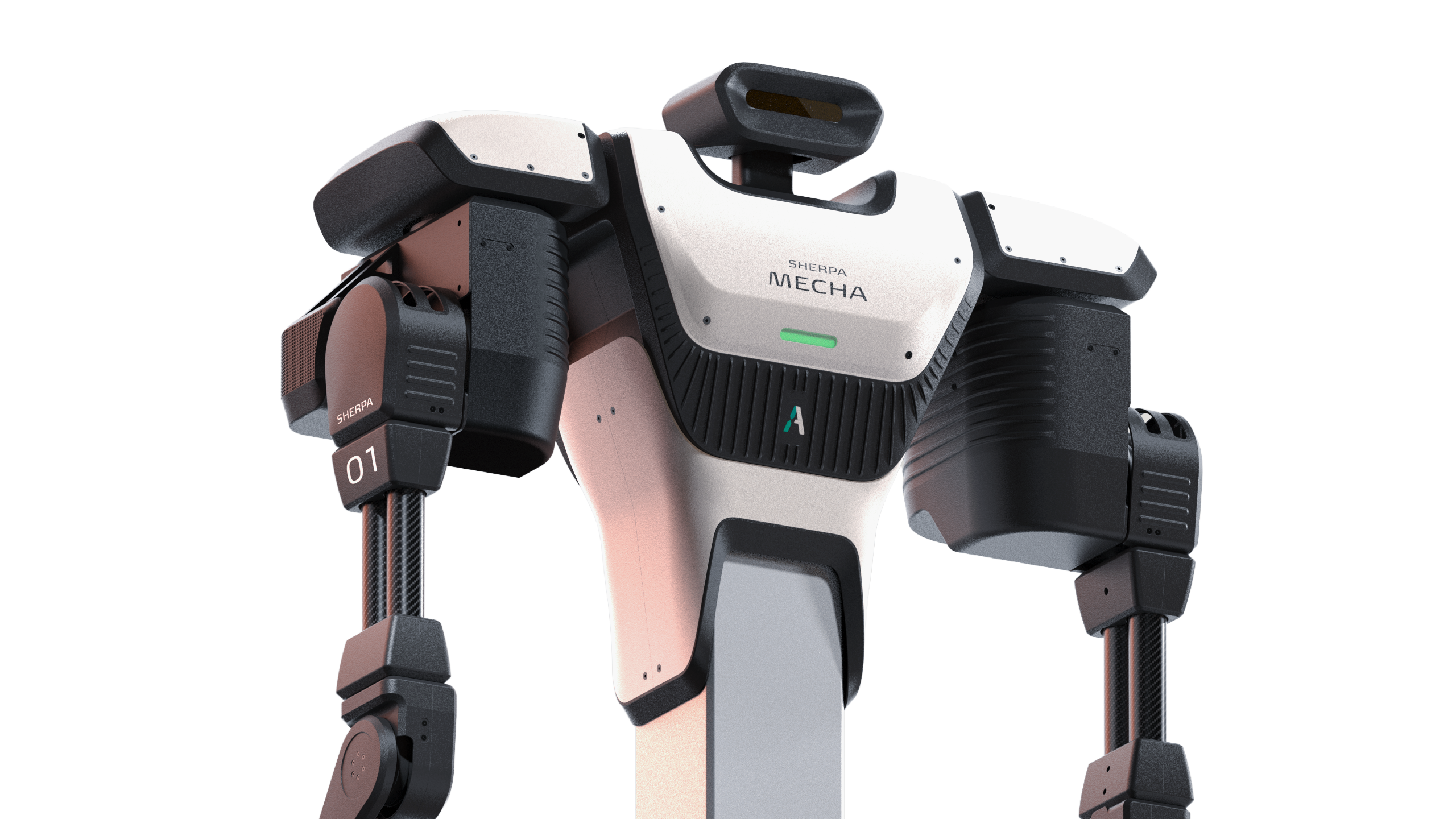
Sherpa Mecha industrial humanoid robot, close detail of shoulder and torso

Built Not for Show.
Built for Work.

Sherpa Mecha is an industrial humanoid robot from Ati Robotics — a dual-arm mobile manipulator that drives, reaches, and handles in one continuous workflow, moving light-to-medium loads up to 26 lb (12 kg) between bins, conveyors, workstations, and shelves without fixturing changes.

26 lbs(12 kg)
Payload
19
Degrees of Freedom
35 in(900 mm)
Reach
3.4 mph(1.5 m/s)
Max Speed

What Is the Sherpa Mecha?

The Sherpa Mecha is an industrial humanoid robot from Ati Robotics: a dual-arm mobile manipulator that drives, reaches, and handles in one continuous workflow. It's humanoid-inspired — two dexterous arms and an adjustable-height torso — but it isn't bipedal. The robot moves on Ati's proven autonomous wheeled base instead of legs, for faster, safer, cage-free operation on a real factory floor.

Ati Robotics brings deep strength in mobile robotics for manufacturing to the humanoid space. Sherpa Mecha is built to integrate into existing workflows for real-world manufacturing tasks — not demonstrations, not research labs.

Engineered as One System

Mobile Autonomy
Sherpa Mecha rides on Ati's proven autonomous wheeled base — the same navigation stack fielded across thousands of Sherpa deployments — so it moves between bins, conveyors, and workstations without floor tape, beacons, or infrastructure changes.
Adjustable-Reach Torso
An extending torso moves the robot's arms from floor-level pickups to eye-level placements — 43 in to 78 in (1,100 mm to 2,000 mm) — covering a vertical range a fixed-height cobot can't reach.
Versatile Handling
Dual arms with 19 degrees of freedom handle bins, totes, and parts up to 26 lb (12 kg), moving materials between stations without fixturing changes or task-specific tooling.
AI-Vision
3D LiDAR and camera sensing keep Sherpa Mecha aware of people and obstacles as it works, enabling safe autonomous navigation on an active, populated floor.
Carbon-Fibre Arms
The robot's arms are built from carbon-fibre — the same high strength-to-weight material used in aerospace and motorsport — for dexterous, precise manipulation with less moving mass and no unnecessary bulk.
Modular Architecture
Built as distinct shoulder, arm, and body modules, so troubleshooting is faster, sections are field-replaceable, and downtime stays low — a platform that adapts as your tasks change.
Service-Ready Industrial Build
Engineered for the factory floor, not the showroom: a rugged, service-accessible design means faster maintenance, simpler field service, and more uptime on an active line.
One Purpose-Built System
The dual-arm upper body and autonomous mobile base were engineered as one connected system, so drive, reach, and handle happen in a single continuous workflow — a robot designed as one machine, not an arm retrofitted onto a cart.

The Numbers Behind the Machine

ConfigurationDual-arm mobile manipulator on autonomous wheeled base
Payload26 lbs (12 kg)
Degrees of Freedom19 across dual arms
Reach35 in (900 mm)
Width22 in (580 mm)
Height43 in – 78 in (1,100 mm – 2,000 mm) — extending torso
Max SpeedUp to 3.4 mph (1.5 m/s)
Arm ConstructionCarbon-fibre
Sensors3D LiDAR and Camera
MobilityMobile autonomous base
Battery55 Ah × 2 — 2 hr charge
ApplicationLight-to-medium industrial material handling and machine tending

Sherpa Mecha vs. Other Robots

Sherpa Mecha is built as an industrial alternative to bipedal humanoids — the category that unifies mobility and manipulation. A bipedal humanoid moves like a person but is mostly emerging or pilot-stage technology. A fixed cobot or robotic arm manipulates with precision but can't leave its station. A standard AMR moves freely but can't reach or handle. The robot is built to move autonomously, reach floor-to-eye-level, and manipulate with two arms — on a base that's already fielded across real facilities.

Capability Sherpa Mecha Bipedal Humanoid (e.g. Optimus/Figure) Fixed Cobot / Robotic Arm Standard AMR
Moves autonomously across the floor Yes (wheeled base) Yes (walking) No (fixed) Yes
Dual-arm manipulation Yes (19 DOF) Yes Single arm No
Reach range Floor to eye-level (43 in – 78 in torso) Human range Fixed envelope None
Payload 26 lbs (12 kg) Varies Varies Load-carry only
Deployment Drops into existing workflows, no cages or retrofits Emerging / pilot-stage Needs fixturing and guarding Transport only
Built on a proven platform Yes (fielded Sherpa AMR base) Mostly pre-production Mature Mature
Best for Mobile machine tending and material handling General-purpose (early) Repetitive fixed-station tasks Point-to-point transport

Now Seeking Research and Innovation Partners

Ati Robotics is collaborating with manufacturing organizations to integrate custom tooling and software on the Sherpa Mecha platform. Work with our engineering team to define the application, develop the integration, and deploy the industry's first humanoid-powered production task.

Frequently Asked Questions

What is the Sherpa Mecha?
The Sherpa Mecha is an industrial humanoid robot from Ati Robotics: a dual-arm mobile manipulator (19 degrees of freedom) on an autonomous wheeled base, built to move loads up to 26 lb (12 kg) for manufacturing tasks like machine tending and material handling.
Is the Sherpa Mecha a bipedal humanoid like Tesla Optimus or Figure?
No. It's humanoid-inspired — two dexterous arms and an adjustable-height torso — but it moves on a proven autonomous wheeled base instead of legs, for faster, safer, cage-free operation on a real factory floor.
What can the Sherpa Mecha do?
Machine tending, material transport between bins, conveyors, workstations, and shelves, heavy bin and parts handling, tool changeouts, fastening, and inspection support.
What is the payload of the Sherpa Mecha?
Up to 26 lb (12 kg), for light-to-medium material handling.
How tall is the Sherpa Mecha and how far can it reach?
Its extending torso ranges 43 in to 78 in (1,100 mm to 2,000 mm), with a 35 in (900 mm) arm reach — covering floor-level to eye-level.
How is it different from a cobot or robotic arm?
It adds full autonomous mobility, so it moves between stations instead of working from one fixed position.
What sensors and navigation does it use?
3D LiDAR and cameras (AI-vision) for people and obstacle awareness, and autonomous navigation on an active floor.
What industries is the Sherpa Mecha for?
Automotive, medical and pharma, food and beverage, consumer goods and electronics, heavy equipment, and energy manufacturing.
Who makes the Sherpa Mecha?
Ati Robotics (formerly Ati Motors), with operations in the US, Mexico, India, and Southeast Asia.
Can partners build custom tools on the Sherpa Mecha?
Yes — it's an open, tool-forward platform, and Ati is onboarding research and innovation partners to develop custom tooling and software for specific industrial applications.
What makes the Sherpa Mecha different from other humanoid robots?
It's built for work, not demos: wheeled instead of bipedal, carbon-fibre arms, a modular and serviceable design, and engineered as one system on a fielded AMR base.
How does the Sherpa Mecha compare to Tesla Optimus or Figure?
Tesla Optimus and Figure are bipedal humanoids, most of which are still in emerging or pilot-stage development. Sherpa Mecha takes a different approach: it moves on a wheeled autonomous base instead of legs, which lets it operate on a real factory floor today rather than in a research setting.
What does the Sherpa Mecha cost, and is it available now?
Pricing depends on configuration and deployment scope. Contact our team for a quote and to discuss current availability and pilot program options.